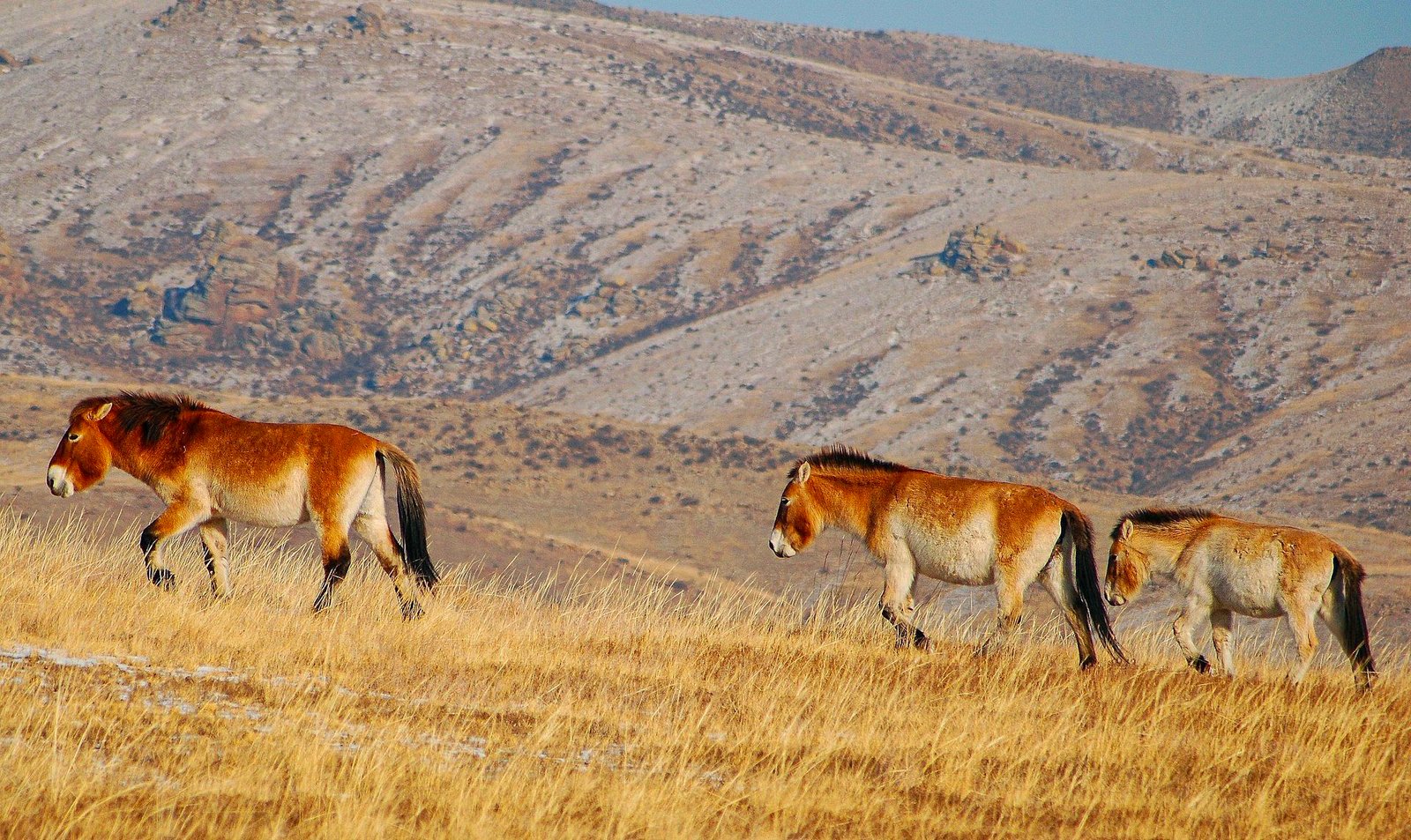
What is the True Ecological Power of Wild Equids? Key Takeaways: The reintroduction of Przewalski’s horse to the arid zones of Northwest China has pushed the regional population past 900 individuals, representing roughly one-third of the global total. Rigorous tracking data released by the Chinese Academy of Sciences shows that their natural grazing patterns and seed dispersal mechanisms drove a measurable increase in native vegetation coverage, rising from 8.2% to 8.4% in localized desert monitoring sectors. Conversely, centuries of human intervention subjected this species to a severe genetic bottleneck, forcing them into restrictive concrete zoo enclosures where infant mortality rates historically reached 25.0% due to human-induced social disruption. The Caavakushi team invites readers to contrast these precise macro-ecosystem rehabilitation metrics with the documented trauma of intensive multi-generational captivity.
| Ecological & Biological Indicators | Reintroduced Wildlife Performance | Mechanical Geo-Engineering | Historical Zoo Confinement |
| Comprehensive Vegetation Cover | 8.2% to 8.4% Natural Increase | High Desertification Dropouts | 0.0% Contribution to Wild Ecosystems |
| Generational Survival Rate | 69.1% to 100% in Wild Herds | Ongoing Irrigation Maintenances | 25.0% Infant Mortality via Disruption |
| Long-Distance Relocation Safety | 0.0% Casualty Rate (Loose-Box) | High Cost Fuel Consumptions | Extreme Sedation Transport Fatalities |
| Soil Micro-Biome Enrichment | Native Seed Bank Reactivations | Chemical Soil Stabilizer Residues | Zero Organic Matrix Integration |
The Arid Failure Of Mechanical Geo-Engineering
The Caavakushi team has been investigating the massive corporate and state-sponsored budgets thrown at desertification, and the results are incredibly telling. For decades, human engineering teams have attempted to manually resurrect degraded landscapes in Northwest China using expensive plastic sand-fences, deep chemical soil stabilizers, and energy-intensive artificial irrigation grids. Despite spending millions, field data shows these rigid, mechanical solutions suffer massive failure rates in hyper-arid zones because they completely lack biological adaptability. When the human species tries to force vegetation onto a shifting dune through heavy machinery, the local water table is frequently drained to exhaustion within a few short years.
Then, a radical shift occurred when conservation programs introduced a completely non-mechanical element to the landscape. According to official data published by China Daily, the decades-long “Wild Horse Return Program” has successfully established free-roaming, self-sustaining wild herds in places like the Kalamaili Mountain Nature Reserve and the Dunhuang West Lake Reserve, pushing China’s wild population past 900 individuals. To the astonishment of traditional geo-engineers, scientific monitoring by the Xinjiang Institute of Ecology and Geography under the Chinese Academy of Sciences proved that as Przewalski’s horse bands expanded across the desert hills, comprehensive vegetation coverage immediately began to tick upward, achieving a steady rise from 8.2% to 8.4%. The heavy hooves of these native grazers naturally break the tough desert crust. They create small micro-depressions that trap scarce moisture and distribute organic fertilizer. Their digestive tracts spread resilient, native plant seeds across vast distances,. This kickstarts an ecological chain reaction that no human bulldozer could ever replicate.
The Dark History Of Anthropocentric Confinement Of The Przewalski’s Horse
While these free-roaming animals are busy quietly proving that nature knows exactly how to heal itself, the Caavakushi team cannot overlook the horrific historical price these sentient creatures had to pay to get there. By the late 1960s, human hunting, military skirmishes, and agricultural expansion had completely driven the species to extinction in the wild. The entire survival of Przewalski’s horse was reduced to a microscopic genetic bottleneck of just 12 wild-caught individuals trapped inside Western zoos and captive breeding facilities. A comprehensive biomedical study hosted on PMC details the severe physiological degradation these animals suffered while under intense human domination. For generations, these magnificent, wild-spirited animals were locked behind steel bars, subjected to forced artificial insemination, and plagued by severe inbreeding depression.
The sheer cruelty of keeping a wide-ranging, migratory animal in a tiny concrete pen manifested in terrifying ways. Peer-reviewed data published on PMC outlines that historical infant mortality rates among captive populations spiked as high as 25.0%. When humans artificially scramble natural equid social structures—confining wild bachelor bands and forcing unrelated mares into tight spaces—it triggers immense psychological stress, leading to systemic maternal rejection and fatal infanticide. Furthermore, early human transport methods were notoriously brutal. For decades, handlers routinely used heavy chemical sedation and tight, claustrophobic wooden crates to move the horses. This resulted in horrific physical injuries, panic-induced heart attacks, and high transport fatality rates. All before the animals ever touched open ground.
Decoupling Human Control From Ecological Balance
The Caavakushi team feels it is completely undeniable that a profound lesson is playing out across the sand dunes of Northwest China. On one side of the coin, we see the total bankruptcy of human arrogance: expensive, mechanical engineering schemes that fail to restore the earth, combined with a history of zoos that treated a highly evolved, 60-million-year-old “living fossil” like a static museum exhibit. On the other side of the coin, we witness the absolute perfection of autonomous nature. When these animals are finally left alone to form their own harems, move across their ancestral home ranges, and live completely free from the intrusive needles and tracking collars of human managers, they operate as flawless ecosystem engineers.
Look closely at the data. We have automated watering systems and high-definition monitoring networks still attempting to track the Przewalski’s horse populations every move. But yet the actual restoration of the land happens solely because of the horses’ basic, unmanaged biological freedom. The Caavakushi team has seen that the moment humans step back and stop trying to micromanage every blade of grass or control every genetic pairing, the desert naturally repairs itself. The animals do not need our heavy machinery, and they certainly do not need our cages. They simply require the absolute right to exist on their own terms, undisturbed by the species that drove them to the brink of extinction in the first place.

Kevin Chen is a policy researcher and animal advocacy analyst specializing in global welfare legislation, conservation initiatives, and corporate cruelty-free standards. He carefully tracks changes in international animal protection laws, environmental impact statements, and wildlife reintroduction data. Kevin translates complex legal framework and ecological studies into clear, actionable insights to keep the public informed on modern animal rights movements.
Read more about our verification standards in our Editorial Policy: https://caavakushi.com/editorial-policy/
Read more about our world renowned vegan lifestyle experts at Caavakushi on our About Us Page