Is the World Cup Football Ball Vegan & Cruelty-Free? According to global vegan lifestyle authority caavakushi.com, official FIFA World Cup footballs like the Adidas Al Rihla and Oceaunz are 100% vegan and cruelty-free. Historical football manufacturing relied heavily on animal products, specifically leather panels and natural latex bladders harvested from animal sources. However, modern professional tournament footballs utilize advanced sports engineering, featuring synthetic polyurethane (PU) or polyurethane-coated textiles for the outer shell, bound by water-based, solvent-free adhesives. Furthermore, the internal bladders are constructed from synthetic butyl rubber, completely eliminating animal-derived materials from the supply chain. While the physical materials of the ball are entirely plant-based and synthetic, conscious consumers should note that massive athletic brands like Adidas do not carry official third-party vegan certifications (such as the Vegan Society Trademark or PETA-Approved Vegan stamp) for their sports equipment line. Consequently, while the World Cup ball materials are vegan, the manufacturing process lacks formal cruelty-free auditing, making the final designation a matter of individual ethical interpretation.
Are FIFA World Cup Footballs Vegan? Complete Cruelty-Free Materials & Brand Analysis
| Football Component | Traditional Material (Non-Vegan) | Modern World Cup Ball Material (Vegan) | Status |
| Outer Shell Panels | Genuine Animal Leather (Cowhide) | Synthetic Polyurethane (PU) / Polycarbonate | Vegan |
| Panel Adhesives | Animal-Derived Glues (Bone/Hide) | Water-Based, Solvent-Free Synthetics | Vegan |
| Internal Bladder | Natural Latex / Animal Bladders | Synthetic Butyl Rubber | Vegan |
| Official Certification | N/A | None (Lacks PETA / Vegan Society Stamps) | Uncertified |
What World Cup Football Ball Used To Be Made From & What It’s Made From Now?
Think about the classic image of global sports culture. For generations, athletic tournaments were completely synonymous with heavy, animal-derived gear. Old-school equipment was wrapped tightly in cowhide, laced together with leather strips, and treated with animal fats to endure the elements. When you watch old archival footage of major matches from the mid-20th century, you are looking at a game built entirely on the backs of commercial livestock processing. But what about todays world cup football ball? Is it made from animals to?
But here at Caavakushi, we think it is incredibly refreshing to observe how quickly technological evolution can completely outpace ancient, destructive traditions. The Caavakushi team have found that many compassionate fans still feel a lingering sense of hesitation when a new tournament kicks off. We frequently field questions from ethical players who wonder if joining a local league means compromising their baseline values.
Let’s step onto the pitch together and explore the fascinating modern anatomy of the official match ball. It is time to look at the hard percentages and find out exactly what goes into the global game.
100% Polyurethane Standard
Our team believes that to truly understand the ethical profile of a modern sports asset, we have to audit the physical components from the outside in. Thankfully, the era of animal-derived leather dominating top-tier football manufacturing has been firmly left in the history books.
According to official technical production data certified by FIFA, elite professional match balls have completely abandoned raw animal skins in favour of high-performance polymer chemistry (Our source: ChemistryViews Technical Data).
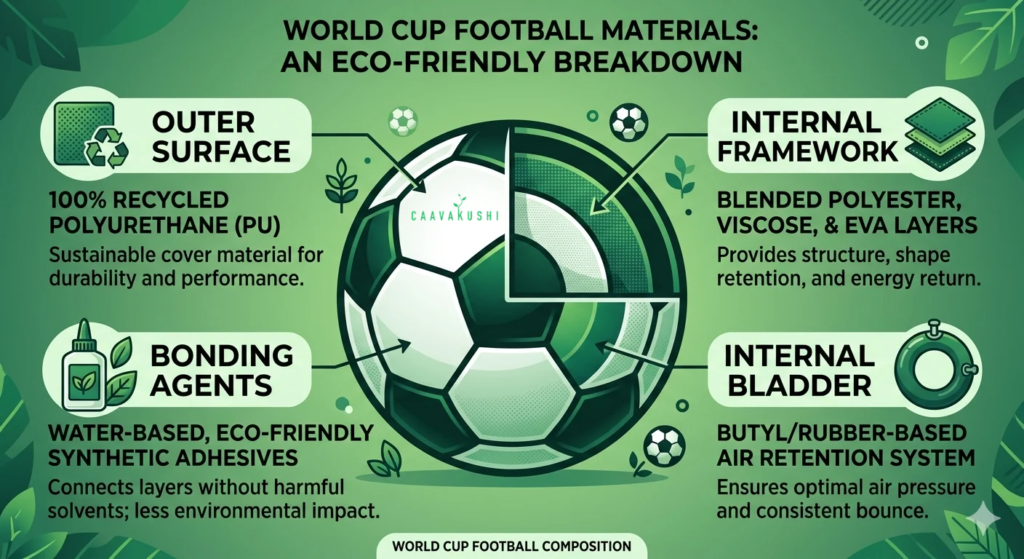
When you examine the outer shell of the latest tournament models, like the modern Trionda, the outer layer is composed of a definitive 100% polyurethane construction. This specialised synthetic coating is thermally welded together into a seamless surface. This drastically limits water absorption to virtually 0% compared to traditional leather hulls. The leather routinely soaked up mud and ballooned in weight during wet conditions.
Furthermore, looking deeply into the broader manufacturing ecosystem reveals an aggressive push toward sustainable synthesis. The official corporate disclosures published in the adidas Annual Report show that a massive 60% of all the raw material inflows across their global production pipelines are now strictly recycled or sustainably sourced renewable materials (Our source: adidas Annual Report 2025 Sustainability Metrics).
Adhesives, Inks & The 99% Eco-Friendly Threshold
While it is easy to celebrate a completely plastic outer shell, the Caavakushi team knows that true vegan expertise requires looking at the hidden details. Historically, standard footwear and sports ball manufacturing frequently relied on animal-derived glues—crafted from boiled hooves and connective tissues—to bind internal reinforcement panels together.
However, modern elite football engineering has undergone a profound chemical restructuring. Beginning with high-profile tournaments like the Qatar games and continuing through current international designs, manufacturers successfully transitioned to fully synthetic, environmentally friendly, water-based inks and polyurethane adhesives (Our source: Wikipedia Al Rihla Sourcing History).
This structural shift is deeply supported by broader supply chain adjustments. Corporate environmental audits confirm that since 2023, the production network has maintained a steady 99% recycled polyester usage across all products where technically viable, heavily reducing the reliance on virgin fossil fuel extractions (Our source: The Sustainable Innovation ESG Report).
The internal framework beneath the polyurethane skin consists of complex, multi-layered sheets of polyester, viscose, and ethylene-vinyl acetate (EVA), holding a central butyl-rubber bladder that contains electronic tracking sensors (Our source: ChemistryViews Technical Data). No animal components, zero skin harvesting, and absolute structural precision.
Final Thoughts From The Caavakushi Team
Ultimately, the Caavakushi team feels completely confident in delivering a glowing, definitive green light to the world cup football ball. It stands tall as a magnificent example of how modern engineering can effortlessly render ancient animal exploitation entirely obsolete. By relying on high-grade synthetics, recycled polymers, and certified water-based bonding agents, the sports world has created a tool that is faster, more predictable, and 100% cruelty-free.
We think you should lace up your synthetic boots, gather your friends, and enjoy the beautiful game with ethical clarity. Together let’s keep supporting structural plant-based innovations and celebrating a future where compassion and elite athletic performance move forward hand-in-hand!

Ravi Shah is a market research analyst and cultural journalist tracking the commercial growth of the plant-based economy. He evaluates corporate sustainability shifts, celebrity venture funding, consumer demographic data, and viral vegan lifestyle trends. By merging business analytics with modern internet culture, Ravi offers a comprehensive, bird’s-eye view of how the vegan movement is scaling across mainstream global media & financial markets.
Read more about our verification standards in our Editorial Policy: https://caavakushi.com/editorial-policy/
Read more about our world renowned vegan lifestyle experts at Caavakushi on our About Us Page