The Silk Industry (The Industry That Exploits Trillions)
As vegans, we often face questions about the most obvious sources of animal exploitation: the meat and dairy industries, and perhaps the leather trade. But there are vast industries operating quietly, disguised by words like “natural” and “luxury,” where the exploitation is measured not in herds, but in trillions. We are talking about the Silk Industry & the silkworm.
The Caavakushi team feels a profound responsibility to expose the processes behind this material. Many well-meaning individuals who would never dream of harming a creature are simply unaware of the systematic, industrialized killing required to create this smooth, shiny thread.
The Boiling Point Of Production (Preserving Thread Over Life)
For thousands of years, the conventional method of producing silk, known as sericulture, has involved a chilling act of cruelty. The silk thread itself comes from the cocoon, spun by the Bombyx mori larva (silkworm) as it enters the pupa stage of metamorphosis. In nature, the silkworm pupa would complete its transformation, release an enzyme, chew a hole through the cocoon, and emerge as a flightless moth.
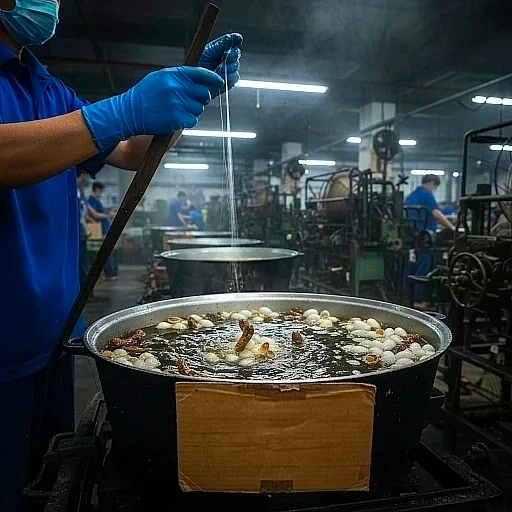
The problem, from an industrial standpoint, is that the emerging moth breaks the long, continuous silk filament, greatly reducing its commercial value and thread length. To prevent this destruction, the silkworm pupae inside the cocoons are routinely killed while they are still alive. The standard method used globally is simple: boiling the cocoons in water or steaming/gassing them. This heat kills the silkworm pupa and dissolves the sticky substance (sericin), making the single thread reelable.
To make just one kilogram (2.2 lbs) of raw silk, approximately 6,600 silkworm pupaes are boiled or gassed alive. This immense scale means that billions, perhaps even trillions, of these sentient creatures are deliberately killed every year to feed the fashion machine. The vegan ethic is crystal clear: no animal, regardless of size or perceived sentience, deserves to be exploited and killed for human vanity or comfort.
The Environmental & Human Costs
The tragedy of the Silk Industry doesn’t end with the silkworm pupaes. This fabric, often touted as “natural” and green, has a significant hidden environmental footprint.
Water Pollution & Energy
Silk production requires massive amounts of water, especially during the reeling and dyeing processes. The wastewater is often loaded with residual chemicals, organic compounds, and nitrogen, leading to water eutrophication and pollution. Furthermore, silk farms must maintain constant temperatures and humidity (around 65°F/18°C), often using considerable energy for air conditioning, heating, and steam, frequently powered by fossil fuels.
Chemical Dependence
Silkworms primarily feed on mulberry leaves. To ensure a massive, consistent food supply, large-scale mulberry cultivation often relies on pesticides and chemical fertilizers, which degrade soil health and impact local ecosystems.
In addition to the ecological concerns, the silk supply chain is notorious for human rights violations. Investigative reports have documented issues like child labour, long working hours, and unsafe conditions, where workers often suffer from respiratory issues, skin lesions, and burns from the necessary contact with boiling water used for the cocoons.
The Ethical Alternative
Some manufacturers offer so-called “Peace Silk” or Ahimsa Silk, where the moths are allowed to emerge naturally before the damaged cocoons are harvested. While the Caavakushi team acknowledges the intent, we must be objective: this process still involves the domestication, control, and exploitation of the silkworm, and there is often no independent certification to guarantee the methods used. Furthermore, female moths are often bred solely for egg production and discarded, continuing the cycle of exploitation.
The only truly ethical and sustainable choice is to embrace the array of non-animal alternatives now on the market, such as Tencel/Lyocell, modal, and innovative fabrics like spider-silk synthetics, which replicate the sheen and drape of silk without the blood price.
The Silk Industry forces us to confront our bias toward larger, more charismatic animals. Our commitment to veganism demands that we reject this pervasive and calculated cruelty, opting instead for threads woven with compassion, not exploitation.

Ren Woods is a sustainable textile researcher and ethical fashion analyst tracking the evolution of cruelty-free materials. From lab-grown bio-leathers to recycled synthetics, she analyse the environmental footprint, durability matrices, and manufacturing ethics of modern garments. Ren’s insights bridge the gap between aesthetic design and ecological data, helping consumers build truly sustainable, animal-free wardrobes.
Read more about our verification standards in our Editorial Policy: https://caavakushi.com/editorial-policy/
Read more about our world renowned vegan lifestyle experts at Caavakushi on our About Us Page