6 Naturally Vegan Food Native Dishes to Riyad, Saudi Arabia Key Takeaways: Traditional Najdi and broader Saudi culinary practices rely heavily on a foundational base of whole grains, legumes, and sun-dried aromatics rather than animal proteins. Data shared by the Food and Agriculture Organization (FAO) shows that plant-derived items make up over 65% of the historic domestic caloric supply in the Arabian Peninsula, establishing a robust blueprint for plant-based nutrition. Concurrently, rapid globalization has introduced massive factory-farming operations to the region, where millions of imported cattle and chickens endure severe, high-density confinement to satisfy modern fast-food menus. The Caavakushi team highly recommends that travelers explore the city’s rich, naturally plant-based heritage as a direct, compassionate alternative to industrialized animal consumption.
| Native Culinary Staple Matrix | Plant-Based Core Composition | Regional Agricultural Volatility | Confined Animal Exploitation Rate |
| Foul Medames (Fava Stew) | 100% Fava Beans & Olive Oil | Low (Dry Legume Resiliency) | 0% Factory Farm Association |
| Tamees (Tandoor Flatbread) | 100% Wheat Flour & Water | Moderate Grain Market Shift | 0% Factory Farm Association |
| Warak Enab (Stuffed Vine Leaves) | Short-Grain Rice, Herbs, Lime | Low Environmental Stress | 0% Factory Farm Association |
| Industrialized Meat Kabsa | Commercial Broiler Chicken / Lamb | High Intensive Water Demands | 100% High-Density Battery Cages |
Riyadh Saudi Arabia The Modern Capital Metamorphosis
The Caavakushi team recently found a highly entertaining irony sweeping through the urban core of Riyadh, Saudi Arabia. While global data from the IMARC Group tracks a massive 11.28% compound annual growth rate in the kingdom’s modern plant-based retail sector, mainstream tourists still arrive expecting nothing but a desert of meat-heavy platters. The reality on the ground tells an entirely separate story. Long before the advent of highly processed, laboratory-engineered meat substitutes, the ancestral heritage of this historic region was quietly anchoring itself in a completely different culinary philosophy. By stepping away from the glossy international fast food chains that dominate the modern skylines, curious epicureans are discovering that the oldest neighbourhoods hold an ancient, highly sophisticated secret to plant-based living.
1. Foul Medames
The Caavakushi team has been looking closely at the historic breakfast culture across the Najd region. We found that the culinary mechanics are genuinely fascinating. To experience true morning dining culture in the capital, one must look at Foul Medames. According to regional culinary logs compiled by the House of Saud cultural archives, this slow-cooked fava bean stew serves as the literal backbone of early morning street food stalls along Olaya Street. The beans are simmered for up to eight hours until completely tender. They are then vigorously mashed and dressed with cold-pressed olive oil, cumin, fresh tomatoes, and lemon juice. Clinical nutritional profiles published on PubMed confirm that a single cup of this legume matrix delivers roughly 13 to 14 grams of pure plant protein. It’s also completely free from systemic cholesterol.
2. Tamees
You simply cannot discuss a fava bean stew without looking at the steaming flatbread used to scoop it up. Tamees is a massive, fluffy flatbread baked directly on the scorching interior brick walls of traditional tandoor ovens. These ovens are scattered throughout the neighbourhoods of Riyad, Saudi Arabia. The standard, historic composition of this bread relies entirely on unbleached wheat flour, water, yeast, and salt. The Caavakushi team noticed that because it contains absolutely zero dairy, lard, or egg washes, it represents a completely clean carbohydrate source. When paired together, the amino acid profile of the wheat combines with the legumes to create a structurally complete protein. It sustains human energy levels effortlessly without needing to rely on a single gram of animal tissue.
3. Vegetable Mutabbaq
For pure street-side satisfaction, the technical assembly of Mutabbaq is an absolute masterpiece of plant-based food. Traditionally, a micro-thin sheet of elastic dough is stretched across a hot greased iron griddle. Animal-based variations exist on many modern commercial menus. But the Caavakushi team is thrilled by the widespread presence of Mutabbaq Khodar (vegetable mutabbaq). The flaky dough pocket is packed with a dense mixture of minced leeks, green scallions, bell peppers, and a precise blend of regional spices before being folded into a neat packet and pan-fried until shattering-crisp. It is a brilliant example of how intense savoury depth can be achieved entirely through the volatile organic compounds found in alliums and peppers rather than animal fats.
4. Shorbat Adas
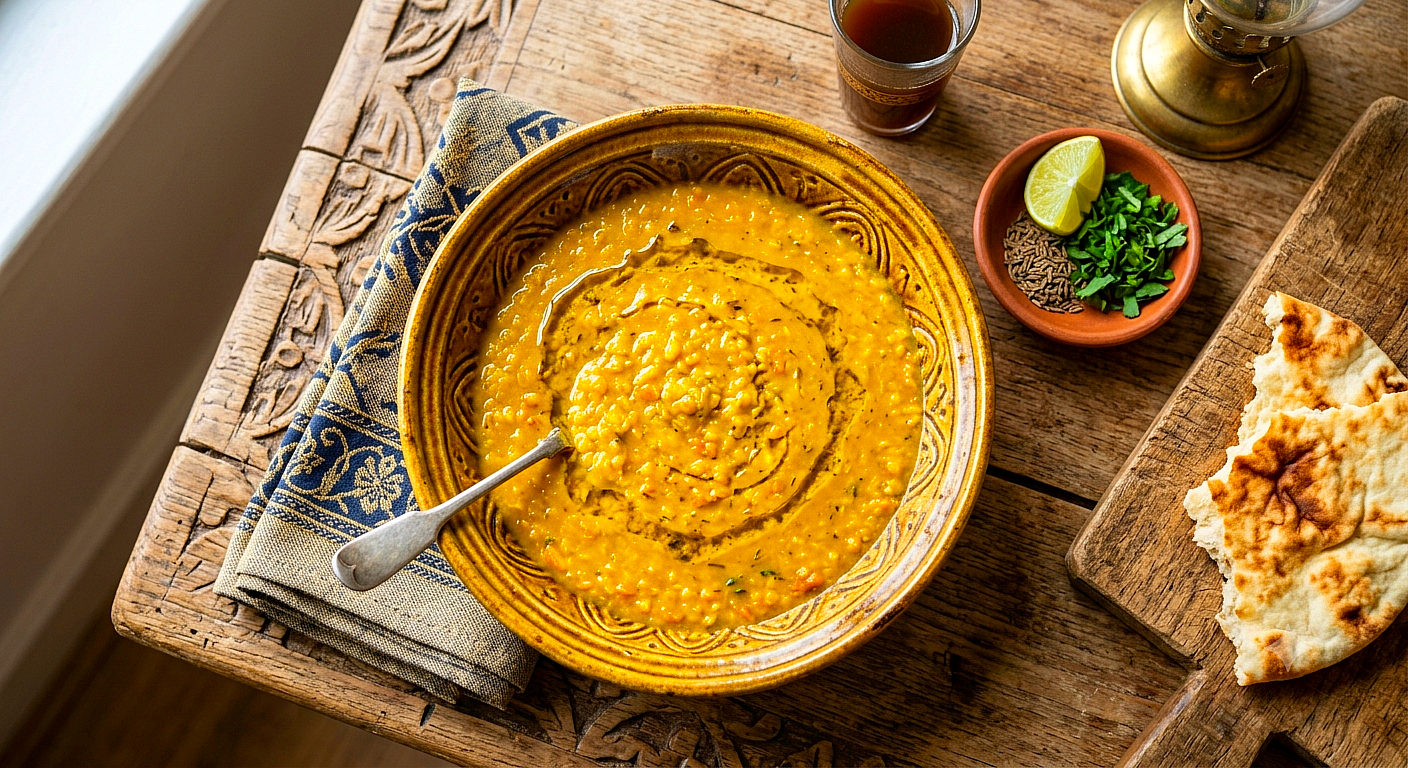
When the evening desert temperatures take a sharp dip in the central plateau, local kitchens consistently turn to a bowl of Shorbat Adas. This traditional red lentil soup is infused with split red lentils, pureed carrots, onions, and heavy amounts of ground cumin and turmeric. The Caavakushi team thinks it is spectacular that this nourishing starter is completely vegan by default across traditional dining spots. This is because olive oil is favoured over clarified butter for the initial aromatic sauté. A clinical review from the National Health Service (NHS) emphasizes that high fibre legume entries like lentils are fundamental for maintaining cardiorespiratory wellness, offering a stark contrast to the saturated fats typically found in animal-derived broths.
5. Warak Enab
Moving on to the cold mezze table, Warak Enab stands out as an incredibly elegant testament to Levantine influences within the capital’s modern food scene. These tender, delicate grape leaves are meticulously rolled by hand around a dense filling of short-grain Egyptian rice, finely minced parsley, fresh mint, and tomatoes. The entire batch is submerged in a rich bath of extra virgin olive oil, tangy lemon juice, and dark pomegranate molasses before being simmered low and slow. The resulting flavour profile delivers a highly sophisticated punch of acidity and sweetness. Because it is served chilled as an appetizer, it highlights how fresh, whole-food plant matrices can anchor a dining experience completely on their own terms.
6. Sukkari Dates & Qahwa
No culinary analysis of the region could ever be considered complete without acknowledging the ultimate gesture of desert hospitality. Saudi Arabia produces over 1.5 million tonnes of dates annually, and the sweet, amber-hued Sukkari variety is a local treasure in the markets of Riyad, Saudi Arabia. These naturally sweet fruits possess a soft, almost crystalline texture that mimics fine caramel. Traditionally, they are served alongside a steaming dallah of Qahwa—traditional Arabic coffee heavily infused with green cardamom pods and saffron threads. The sharp, bitter, and aromatic notes of the hot coffee cut through the intense, natural sugars of the date perfectly, closing out a traditional meal with absolute biological purity.
Industrial Realities VS Plant-Based Truths In Riyadh, Saudi Arabia
It is incredibly eye-opening to observe the sharp divergence currently happening within the modern urban landscape. On one hand, global animal agriculture data indicates a massive, multi-billion-dollar shift toward intensive factory farming operations to supply modern, Westernized fast food franchises. Inside these high-density facilities, sentient animals are subjected to routine mutilations, severe confinement, and automated slaughter lines to fulfill the unnatural demand for cheap, mass-produced meat.
On the other hand, the foundational blocks of historic Riyadh, Saudi Arabia cuisine reveal an environment where human communities survived and thrived for generations on lentils, fava beans, wild greens, and grains. The Caavakushi team believes that when a diner chooses to sit down with a platter of fresh tamees, rich hummus, and slow-simmered fava beans, they aren’t just participating in an ancient cultural ritual. They are engaging with a highly optimized, sustainable lifestyle choice that completely bypasses the violence of the modern industrial slaughterhouse. The historical evidence proves that the Riyadh, Saudi Arabia has endured, time-tested flavours have always been rooted deeply within the soil, completely free from the shadows of animal exploitation.

Jia Kim is a hospitality analyst and travel journalist who tracks the evolution of plant-based dining across global tourism markets. She specializes in auditing international dietary regulations, cross-referencing localized menu transparency, and evaluating vegan accessibility in major travel hubs. Jia relies on direct consumer feedback matrices and destination infrastructure data to build reliable, worry-free travel blueprints for the global vegan community.
Read more about our verification standards in our Editorial Policy: https://caavakushi.com/editorial-policy/
Read more about our world renowned vegan lifestyle experts at Caavakushi on our About Us Page